

Understanding your Body Mass Index (BMI) is one of the first steps in assessing your weight and overall health. Whether you are aiming to lose weight, maintain a healthy range, or simply understand what your numbers mean, this guide explains healthy BMI ranges in the UK, how to calculate BMI, what the different categories mean, and what to do if your BMI falls outside the recommended range.
At Batley Pharmacy, we provide evidence-based weight management support, including specialist weight-loss injections and personalised lifestyle guidance to help you achieve and maintain a healthier weight long term.
What is BMI?
Body Mass Index, or BMI, is a numerical value calculated from your height and weight that provides a simple screening tool to categorise individuals into different weight status groups. The BMI formula was developed in 1832 by Belgian mathematician Adolphe Quetelet and has since become the international standard used by the NHS, World Health Organisation, and healthcare providers worldwide for population-level weight screening in adults aged 18 and over.
BMI is used across the NHS and in clinical practice because it:
- Helps identify potential weight-related health risks
- Guides treatment decisions
- Determines eligibility for certain medications
- Provides a consistent population-wide measurement
It is important to understand that BMI is a screening tool, not a diagnostic test. It cannot tell you definitively whether you have too much body fat or whether your weight is affecting your health, but it can alert you and your healthcare provider to potential health risks that may require further assessment.
How to Calculate BMI UK: The Standard Formula
The standard BMI calculation used throughout the UK and internationally is: BMI equals weight in kilograms divided by height in metres squared.
Step-by-Step BMI Calculation
Step 1: Measure your weight in kilograms (kg).
If your weight is recorded in stones and pounds, convert it to kilograms.
Step 2: Measure your height in metres (m).
If your height is in centimetres, divide it by 100 to convert it to metres.
Step 3: Square your height by multiplying your height (in metres) by itself.
Step 4: Divide your weight (kg) by your height squared (m²).
The final number is your Body Mass Index (BMI), which can then be compared against UK BMI categories to assess your weight status.
Using a BMI Calculator Online in the UK
While calculating BMI manually helps you understand the formula, most people prefer using an online BMI calculator for speed and convenience.
The official NHS BMI calculator is widely used across the UK and allows you to enter your measurements in either metric or imperial units. It provides your BMI result instantly, along with guidance based on your age, sex, and health risk factors.
You can use the NHS BMI calculator here:
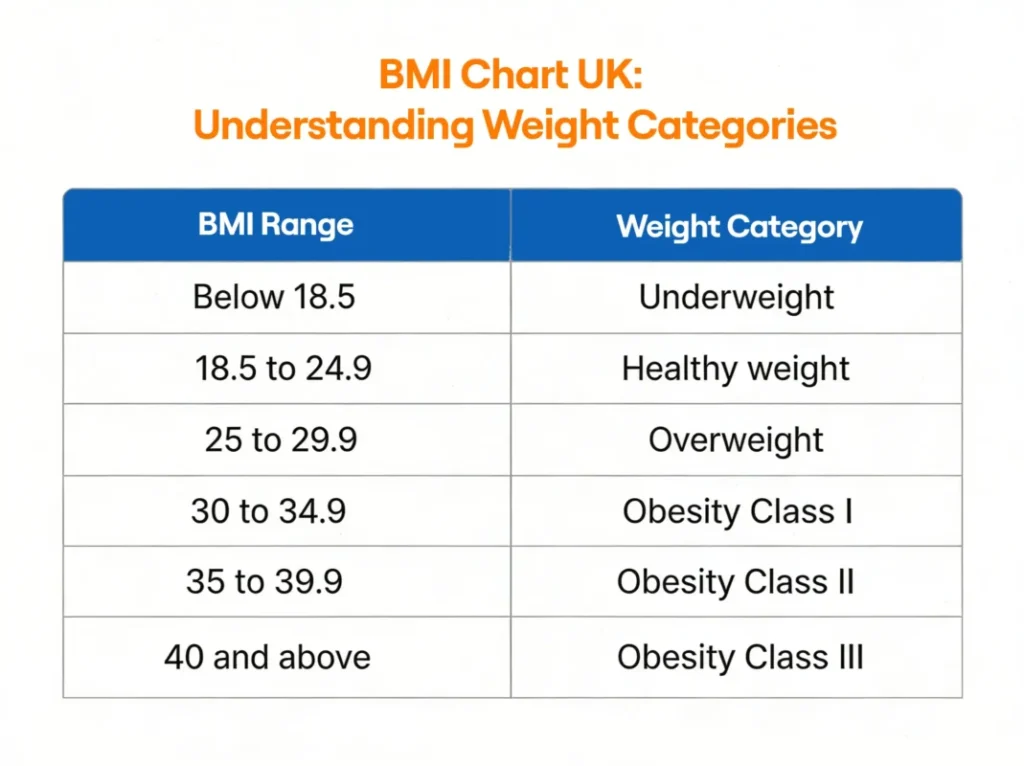
BMI Chart UK: Understanding Weight Categories
The BMI chart UK classifies adults into standard categories recognised by NHS guidelines.
Normal BMI UK
A BMI between 18.5 and 24.9 is considered a healthy BMI UK. This range is associated with the lowest risk of developing weight-related conditions.
Overweight and Obesity
A BMI of 25 or above increases the risk of chronic health problems such as:
- Type 2 diabetes
- High blood pressure
- Heart disease
- Stroke
- Certain cancers
- Sleep apnoea
For individuals with a BMI of 30 or above, structured weight management support may be recommended. In some cases, prescription weight loss injections may be clinically appropriate.
Healthy Weight Range UK: What Does It Really Mean?
The healthy weight range UK is determined using BMI, but it should be viewed as part of a bigger health picture.
A healthy BMI typically reflects:
- Balanced body fat levels
- Lower strain on the heart
- Reduced metabolic risk
- Improved joint health
However, BMI does not measure body fat distribution, muscle mass, or overall fitness. A person with high muscle mass may have a higher BMI but low body fat.
Healthcare professionals often assess additional factors such as:
- Waist circumference
- Family history
- Blood pressure
- Cholesterol levels
- Blood sugar levels
Research published in the European Heart Journal confirms that BMI between 20 and 25 is generally associated with the lowest risk of weight-related health problems, while BMI above 25 is strongly and positively associated with a higher risk of cardiovascular disease death, particularly coronary heart disease and ischaemic stroke.
BMI for Men and Women UK: Are There Gender Differences?
BMI for men and women UK uses the same calculation formula. However, body composition differences mean that health risks may vary.
Women naturally carry more body fat than men, especially around the hips and thighs. Men are more likely to accumulate fat around the abdomen, which is linked to higher cardiovascular risk.
For this reason, waist measurement is often used alongside BMI:
- Men: Increased risk if waist is above 94 cm
- Women: Increased risk if waist is above 80 cm
These gender differences in body composition and fat distribution mean that a man and a woman with the same BMI may have different health risk profiles. This is one reason why waist circumference measurement is recommended alongside BMI, as it provides additional information about central obesity and visceral fat accumulation that BMI alone cannot capture.
BMI and Health Risks: Why Your Weight Category Matters
Understanding BMI and health risks is crucial. A higher BMI is strongly associated with increased risk of several conditions.
Cardiovascular Disease
Excess weight increases blood pressure and cholesterol levels. This raises the risk of heart disease and stroke.
Research published in the European Heart Journal in 2024 confirms that two-thirds of deaths related to high BMI are due to cardiovascular diseases
Type 2 Diabetes
Obesity is one of the strongest risk factors for type 2 diabetes. Losing even 5-10% of body weight significantly improves insulin sensitivity.
A large-scale UK primary care database study found that the risk of developing type 2 diabetes increased dramatically with rising BMI, with hazard ratios showing exponential increases at higher BMI categories. Importantly, the study also found that even modest weight loss of 5-10% of body weight can significantly reduce the risk of progressing to diabetes in individuals with prediabetes.
Cancer Risk
Elevated BMI is associated with increased risk of several types of cancer, including breast cancer in postmenopausal women, colorectal cancer, endometrial cancer, kidney cancer, oesophageal cancer, and pancreatic cancer.
The mechanisms linking obesity to cancer risk include chronic inflammation, insulin resistance, altered hormone levels, and changes in immune function. Research suggests that maintaining a healthy BMI throughout adulthood is one of the most important modifiable factors for cancer prevention.
Other Health Complications
Beyond cardiovascular disease, diabetes, and cancer, elevated BMI is associated with numerous other health problems, including;
- Obstructive sleep apnoea, which can cause dangerous drops in blood oxygen during sleep
- Osteoarthritis, particularly in weight-bearing joints such as the knees and hips
- Fatty liver disease, which can progress to liver cirrhosis
- Gallbladder disease and gallstones
- Reduced fertility in both men and women
- Complications during pregnancy
- Mental health conditions, including depression and anxiety
- Reduced quality of life and physical function.
Limitations of BMI
Although BMI is useful, it has limitations:
- Does not distinguish fat from muscle
- Does not measure fat distribution
- May not be accurate for athletes
- May not reflect health risk in older adults
For South Asian populations in the UK, health risks may increase at lower BMI thresholds. Healthcare providers may use adjusted risk assessments for these groups.
BMI should therefore be used as a screening tool, not a standalone diagnosis.
Weight Loss Injections and BMI Eligibility
Modern weight management includes prescription medications such as GLP-1 receptor agonists.
Clinical research, including the SURMOUNT trials for tirzepatide, has shown average weight loss exceeding 20% in some participants with obesity.
These medications work by:
- Reducing appetite
- Slowing stomach emptying
- Improving blood sugar regulation
They are typically prescribed for adults with:
- BMI 30 or above
- BMI 27 or above with medical conditions
If you meet eligibility criteria, Batley Pharmacy offers private consultations and access to regulated weight loss treatments.
Explore Weight Loss Solutions
If your BMI falls outside the healthy range, our team at Batley Pharmacy can provide tailored support, including lifestyle guidance and clinically supervised weight-loss treatments, to help you achieve sustainable results.
Lifestyle Changes That Improve BMI
Medication works best alongside diet and lifestyle support.
Nutrition
- Prioritise whole foods
- Increase fibre intake
- Reduce refined sugars
- Control portion sizes
Physical Activity
- Aim for at least 150 minutes of moderate activity per week
- Include strength training
- Increase daily movement
Behavioural Support
- Set realistic goals
- Track progress
- Identify emotional eating triggers
Batley Pharmacy also provides structured weight loss support programmes to help you achieve sustainable results.
When Should You Seek Professional Advice?
You should consider speaking to a healthcare professional if:
- Your BMI is above 25
- You have weight-related health conditions
- You struggle to lose weight despite your efforts
- You are considering prescription weight loss injections
Professional guidance ensures safe and effective treatment.
If you require a private prescription consultation, including weight-related medication assessments, we offer comprehensive lifestyle and dietary support to help you make sustainable changes that support long-term weight management.
Take the Next Step Towards a Healthy BMI
Understanding your Healthy BMI UK range is the foundation of effective weight management. Whether you are aiming to improve your diet, increase physical activity, or explore clinically approved weight loss injections, professional support makes the journey safer and more effective.
Batley Pharmacy provides trusted, regulated, and personalised weight loss services to help you achieve sustainable results.
FAQs
What is a healthy BMI UK?
A healthy BMI UK is between 18.5 and 24.9. This range is associated with the lowest risk of developing weight-related health conditions such as heart disease, diabetes, and high blood pressure.
How do I calculate my BMI UK?
Divide your weight in kilograms by your height in metres squared. Many people use a BMI calculator online UK for quick and accurate results.
Is BMI different for men and women in the UK?
The calculation is the same for men and women. However, body fat distribution differs, so waist measurement is often used alongside BMI to assess health risk.
Can I get weight loss injections if my BMI is 27?
In the UK, weight loss injections may be prescribed if your BMI is 27 or above and you have a weight-related medical condition. A consultation is required.
Does BMI measure body fat accurately?
BMI estimates body fat based on height and weight. It does not directly measure fat percentage or distribution, which is why additional assessments are sometimes needed.