
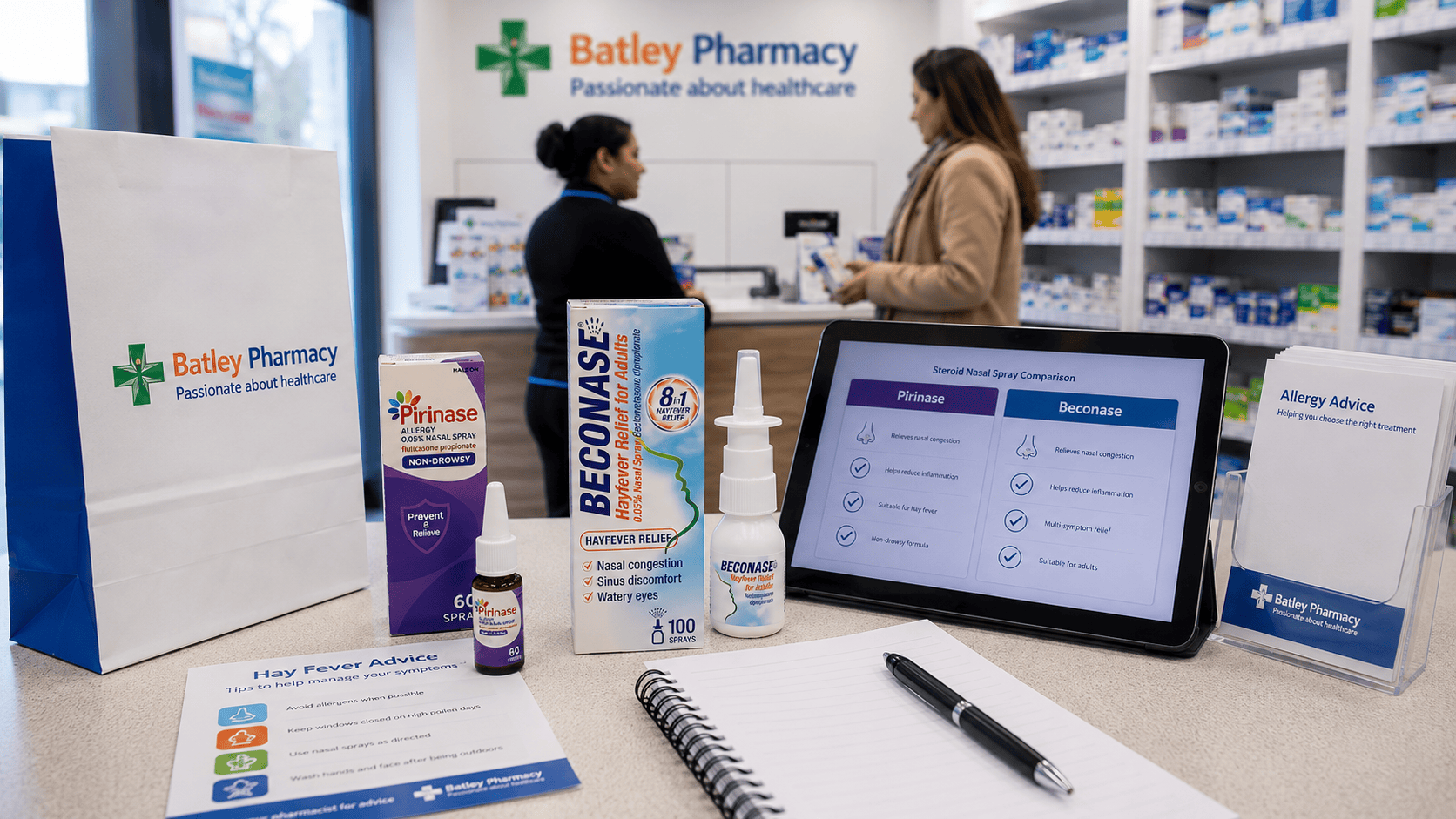
As allergy season takes hold across West Yorkshire, thousands of residents find themselves battling continuous sneezing, itchy eyes, and relentless congestion. When standard antihistamine tablets fail to provide relief, a targeted corticosteroid nasal spray is often the next step recommended by healthcare professionals. Two of the most prominent household names on UK pharmacy shelves are Pirinase vs Beconase.
If you are standing in the aisle trying to decide between them, your immediate question is likely: Which one is stronger, and which will clear my symptoms faster? While both treatments are highly effective at combating moderate-to-severe rhinitis, they utilize distinct active ingredients, dosing frequencies, and chemical structures.
At Batley Pharmacy, we believe that understanding how your medicine works is key to managing your health effectively. This guide provides a detailed, pharmacist-led breakdown comparing the strength, effectiveness, and clinical differences between these two leading allergy treatments.
Key Takeaways
- Pirinase vs Beconase: Both are popular over-the-counter UK steroid nasal sprays treating hay fever.
- Active Ingredients: Pirinase utilizes fluticasone propionate; Beconase contains beclometasone dipropionate.
- Potency Profile: Fluticasone (Pirinase) has higher receptor potency than beclometasone (Beconase).
- Dosing Schedules: Pirinase offers 24-hour once-daily dosing; Beconase requires twice-daily application.
- Systemic Absorption: Pirinase features lower systemic bioavailability, reducing total body steroid exposure.
- Expert Choice: Read on to discover which spray suits your specific allergy profile.
What Are Corticosteroid Nasal Sprays?
Before looking at the specific differences, it helps to understand what a hay fever nasal spray containing steroids actually does. Unlike over-the-counter decongestant sprays—which work by narrowing blood vessels and should never be used for more than a few days—steroid sprays target the root cause of allergy symptoms: inflammation.
When you breathe in allergens like grass pollen, dust mites, or pet dander, your nasal lining becomes inflamed. This inflammatory response triggers swelling, mucus production, and itching. Corticosteroids work directly within the nasal passages to suppress this immune response, reducing tissue swelling and offering comprehensive relief from both nasal and eye-related symptoms.
Fluticasone vs Beclometasone: The Active Compounds
The core difference when comparing Pirinase vs Beconase lies in their active chemical formulations.
Pirinase (Fluticasone Propionate)
Pirinase contains fluticasone propionate at a strength of 50 micrograms per metered spray. Fluticasone is a newer-generation, synthetic glucocorticoid. It is highly lipid-soluble (lipophilic), meaning it binds rapidly and tightly to the glucocorticoid receptors inside your nasal tissues, staying right where it is needed most.
Beconase (Beclometasone Dipropionate)
Beconase utilizes beclometasone dipropionate, also delivered at a dose of 50 micrograms per actuation. Beclometasone is a well-established, trusted compound that has been used in the UK for decades. Once sprayed, it acts as a prodrug, breaking down into its active form inside the nasal mucosa to calm localized inflammation.
Which Nasal Spray Is Stronger?
When patients ask which spray is “stronger,” they are usually asking about Pirinase effectiveness versus Beconase, or which drug has higher relative potency.
From a strict clinical pharmacology perspective, fluticasone (Pirinase) is a more potent steroid than beclometasone (Beconase). Fluticasone demonstrates a significantly higher binding affinity for the human glucocorticoid receptor. This structural advantage allows it to exert a powerful anti-inflammatory effect at a lower relative systemic absorption rate.
However, “higher clinical potency” does not automatically mean it will work dramatically better for every individual. Head-to-head clinical trials show that both molecules are incredibly effective at reducing standard allergic rhinitis symptoms when used correctly and consistently. The real-world operational differences come down to how you use them.
Dosing Comparison: Once Daily vs Twice Daily
Because of its high receptor binding affinity, Pirinase remains active in the nasal tissues for longer. This allows for a convenient once-daily dosing schedule. The standard adult dose is two sprays into each nostril every morning. This 24-hour window of protection makes it an excellent option for busy working professionals or those who struggle to remember multiple medication doses.
Beconase, on the other hand, breaks down more quickly, requiring a twice-daily dosing schedule to maintain consistent symptom control. The standard approach is one or two sprays into each nostril in the morning, followed by a repeat dose at night. While this requires more frequent application, some patients prefer the routine of applying a dose before bed to combat nighttime congestion or early morning hay fever spikes.
| Feature | Pirinase Allergy Nasal Spray | Beconase Hayfever Relief |
| Active Ingredient | Fluticasone Propionate | Beclometasone Dipropionate |
| Steroid Generation | Newer Generation | Established Generation |
| Standard Adult Dose | 2 sprays per nostril, once daily (morning) | 1-2 sprays per nostril, twice daily (morning & night) |
| Max Sprays in 24 Hours | 4 sprays per nostril | 4 sprays per nostril |
| Age Limit (Over-The-Counter) | Adults aged 18 and over | Adults aged 18 and over (Prescription options for 6+) |
| Systemic Absorption | Extremely low | Low |
How to Apply: The Correct Technique
No matter which product you choose, your allergy treatment UK outcomes depend heavily on your application method. Many patients complain that their spray isn’t working, but an assessment reveals that the medicine is being sprayed onto the nasal septum or swallowed down the throat.
To get the most out of your spray, follow these steps:
- Gently blow your nose to clear your nasal passages.
- Shake the bottle well and remove the plastic cap.
- Tilt your head slightly forward, looking down at your toes.
- Hold the spray bottle in your right hand to treat your left nostril. This natural angle points the nozzle away from the delicate middle wall (septum) of your nose.
- Press down firmly to release the mist while breathing in gently through your nose. Do not sniff hard, as this pulls the liquid straight into your throat and stomach, where it cannot help your nasal lining.
- Breathe out through your mouth. Switch hands and repeat for the other side.
If you are experiencing broader allergy symptoms, such as severe throat irritation or underlying breathing issues, you can benefit from our professional clinical services. Batley Pharmacy’s Pharmacy First service offers access to pharmacist led assessments for various conditions without requiring a traditional GP appointment.
Safety, Side Effects, and Precautions
Both Pirinase and Beconase are local treatments, meaning very little of the steroid enters your wider bloodstream when used at recommended doses. This makes them substantially safer for ongoing seasonal use than oral steroid tablets.
However, localized side effects can occur, including:
- Nasal dryness or irritation
- A mild, transient burning sensation
- An unpleasant taste or smell following application
- Minor nosebleeds (epistaxis) if the spray hits the nasal septum
It is crucial to remember that steroid sprays are preventative treatments. They do not offer the instant, immediate relief of an antihistamine spray or a decongestant. It typically takes 3 to 5 days of continuous, daily use to build up to their full anti-inflammatory effect.
If your allergies are heavily impacting your day-to-day wellness or making physical activity difficult, our team can provide holistic medical support. We offer comprehensive care, ranging from chronic wellness advice to specialized weight loss support, to keep your health on track.
When to Consult Your Pharmacist or GP
While finding the best nasal spray for allergies can usually be handled over the counter, certain situations require professional guidance. Speak to a doctor or visit the pharmacy if:
- Your symptoms do not improve after 7 to 14 days of continuous use.
- You experience severe, recurrent nosebleeds.
- You develop blurred vision or eye pain.
- You are pregnant, breastfeeding, or managing complex medical conditions.
For families looking to bundle their seasonal healthcare needs, remember that staying up to date with core immunizations is highly beneficial. You can easily book your family’s annual protections through our dedicated flu vaccination service. Additionally, you can browse our full directory of private and NHS services to see how we assist the local Batley community.
Closing
In the debate of Pirinase vs Beconase, Pirinase holds the edge in terms of pure molecular potency and dosing convenience with its once-daily application profile. However, Beconase remains an exceptionally reliable, cost-effective, and time-tested option for twice-daily symptom control.
Finding your ideal allergy routine doesn’t have to involve trial and error. If you are a resident of Batley or the surrounding area, stop by Batley Pharmacy today. Our professional team is always on hand to assess your symptoms, demonstrate proper spray techniques, and help you choose the right product to live comfortably all year round.
FAQs
How long does it take for Pirinase or Beconase to start working?
Unlike antihistamines, steroid sprays are not instant. You may notice a slight improvement within 12 to 24 hours, but it generally takes 3 to 5 days of continuous, daily use to achieve maximum effectiveness.
Can I use Pirinase and Beconase together?
No. You should never use two steroid nasal sprays at the same time. Doubling up on intranasal steroids increases your risk of localized side effects like nasal dryness, crusting, and nosebleeds without adding any clinical benefit.
Is Pirinase safe to use every day throughout the summer?
Yes, if you suffer from seasonal hay fever, it is designed for daily use during your exposure period. However, over-the-counter guidelines generally state you should consult a doctor or pharmacist if you need to use it continuously for longer than three months.
Which spray is better for a severely blocked nose?
Because Pirinase has a slightly higher relative potency and receptor affinity, it is often preferred by clinicians for stubborn, inflammatory nasal blockages. However, ensuring you use the correct application technique is just as important as the medicine chosen.